
Kratom Laws: The Complete Legality Resource
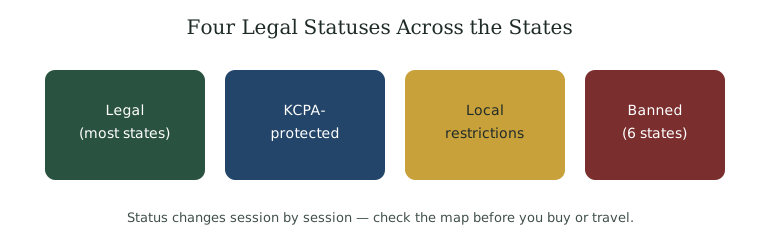
Kratom legality in the United States is a patchwork, not a single rule. The federal government has not scheduled kratom, which leaves the question to the states. As a result, kratom is fully legal in most states, banned outright in a handful, protected by consumer-protection statutes in a growing group, and regulated by age or local ordinance in others. This section maps that patchwork and updates it as legislation moves. Learn what the plant is first in what kratom is.
The National Picture, Honestly
Two federal facts frame everything. First, the Drug Enforcement Administration (DEA) proposed scheduling kratom in 2016, then withdrew the proposal after public and congressional pushback. Secondly, the Food and Drug Administration (FDA) maintains a cautionary posture and has not approved kratom for any use. Neither fact makes kratom federally illegal. Both facts explain why the real action happens in state legislatures.
The State-by-State Directory
The centerpiece of this section is the kratom legality map, re-verified monthly because status changes session by session. Individual state pages go deeper on history and local battles. Start with the six ban states and the most active legislatures, then check your own. The map links every state page as it publishes.
The KCPA Movement
The Kratom Consumer Protection Act (KCPA) is model legislation that regulates rather than bans. A KCPA sets labeling standards, requires lab testing, bans dangerous adulterants, and sets a minimum purchase age. More than a dozen states have adopted a version. The full breakdown lives in the Kratom Consumer Protection Act — the page that best captures this site's advocacy mission.
Travel and Age Rules
Two practical rules trip consumers up. The first is travel. Flying with kratom is generally fine federally, but landing in a ban state is the trap — covered in flying with kratom. The second is age. Federal law sets no minimum age, but states and retailers do, as detailed in kratom age requirements.
Why the Patchwork Exists
The patchwork exists because federal inaction left a vacuum, and states filled it differently. Some legislatures reacted to FDA warnings with bans. Others responded to consumer advocacy with protection statutes. A few did nothing, leaving kratom unregulated but legal. This divergence is why a product legal in one state is a criminal risk one border away — and why a national consumer resource has to track all fifty jurisdictions rather than issue one blanket answer.
Why We Keep the Laws Section Ad-Free
The laws section carries no advertising, and that choice is deliberate rather than incidental. Legal status is the one category of information a consumer must be able to trust completely, because getting it wrong carries criminal risk. An advertisement beside a legality answer would invite the suspicion that the answer was shaped to sell. Removing ads removes that suspicion entirely. This section answers to readers and to the public record — the statutes, the bills, and the map — and to nothing else. That independence is the point of an advocacy organization.
Reading a State Page on This Site
Every state page follows one structure, so the answer is always easy to find. First, the page states current status in the opening line — legal, banned, or regulated. Secondly, it summarizes the legislative history that produced that status. Thirdly, it flags local ordinances and age rules where they exist. Finally, it links back to the national map for context. The state pages are deliberately factual and free of advertising, because legal status is exactly the kind of information that must never appear to be for sale.
Local Rules Inside Legal States
State legality is not the end of the question. Counties and cities inside otherwise-legal states sometimes pass their own restrictions. Sarasota County in Florida is the classic example of a local ban inside a legal state. The lesson for consumers is procedural. First, check state status on the map. Secondly, check for local ordinances where you live or travel. Finally, re-check before any trip, because the map that was accurate last month may have moved.
How Laws Change, and How to Act
Kratom laws change through ordinary politics. Bills appear, committees debate, and consumer testimony matters. Follow active legislation through kratom news, which tracks state bills and FDA actions as they happen. This entire section carries no advertising, by design — the laws pages are the advocacy spine of Truth About Kratom, and they answer to readers alone.
Frequently Asked Questions
Is kratom legal federally?
Kratom is not federally scheduled. The DEA withdrew a 2016 scheduling proposal, and the question is decided state by state.
What is the KCPA?
The Kratom Consumer Protection Act is model legislation that regulates kratom through labeling, testing, adulterant bans, and age limits instead of prohibition.
How many states ban kratom?
Six states currently ban kratom outright. Others regulate it by age or local ordinance, and many have adopted consumer-protection statutes.