Mitragynine & Kratom Alkaloids: The Chemistry Made Plain
Mitragynine is the main active compound in kratom, and understanding it turns marketing names into chemistry you can check. A kratom leaf contains more than 40 alkaloids, but two matter most for consumers: mitragynine, the abundant one, and 7-hydroxymitragynine, a trace one with an outsized reputation. This page explains what these compounds are, how they behave in plain language, and why one number on a lab report tells you more than any strain name. Read it before any strain or extract page, because it is the foundation the rest of the site builds on.
The Alkaloid Roster
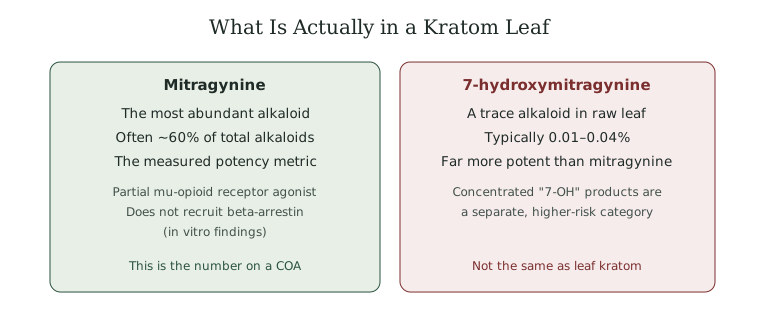
Kratom's chemistry is well characterized, even where its effects are not. In a 2020 study in the Journal of Natural Products, Laura Flores-Bocanegra and colleagues catalogued 19 alkaloids from commercial kratom, updating decades of incomplete data with modern methods (Flores-Bocanegra et al., 2020). Mitragynine dominates that roster, often making up more than half of a leaf's total alkaloids. The rest, including speciogynine, paynantheine, and speciociliatine, appear in smaller amounts. This is one area where kratom science is genuinely solid. We know what is in the leaf, even as questions about effects remain open.
Receptor Pharmacology, Plainly
Mitragynine interacts with the body's opioid receptors, but not the way classical opioids do, and the distinction matters. In a 2020 study in Scientific Reports, Daniel Todd and colleagues found that mitragynine and 7-hydroxymitragynine act as partial agonists at the mu-opioid receptor, and importantly, they did not measurably recruit beta-arrestin, the signaling pathway associated with the most dangerous opioid effects (Todd et al., 2020). "Partial agonist" means a compound that activates a receptor only part way. This is a laboratory finding about mechanism, not a safety promise, and it does not mean kratom is harmless. It means the pharmacology is genuinely different from morphine, which is why researchers study it closely.
Why Mitragynine Percentage Is the Potency Metric
If you learn one practical thing from this page, learn this: mitragynine percentage is the only measurable potency number kratom has. Strain names, colors, and grades are marketing vocabulary. The mitragynine percentage on a certificate of analysis is a measured fact. A product listing 1.5% mitragynine is objectively stronger by that measure than one listing 1.0%, regardless of what either is named. This is why the lab result outranks every label claim, and why learning to read one, covered in how to read a kratom COA, is the most protective skill a kratom buyer can develop. The chemistry gives you a number. The number cuts through the marketing.
The 7-Hydroxymitragynine Story
7-hydroxymitragynine, usually shortened to 7-OH, is where consumers need to be most careful. In natural leaf, it exists only in trace amounts, typically a few hundredths of a percent. But it is far more potent than mitragynine. Research helps explain why it matters. In a 2019 study in ACS Central Science, Andrew Kruegel and colleagues showed that 7-hydroxymitragynine is an active metabolite the body forms from mitragynine, and that it is a much stronger mu-opioid receptor agonist (Kruegel et al., 2019). In ordinary leaf and tea, exposure to 7-OH is minimal. The problem is products that concentrate it artificially, which is a separate story worth its own section.
Concentrated 7-OH Products Are a Different Category
Concentrated 7-OH products are not the same thing as kratom leaf, and regarding them as equivalent is a serious mistake. A growing market sells chemically enriched or semi-synthetic 7-hydroxymitragynine, often marketed as "kratom" despite being chemically distinct. In a 2025 review in Pharmaceutical Biology, Scott Alsbrook and colleagues concluded that these concentrated 7-OH products are pharmacologically and toxicologically distinct from leaf and pose significantly higher risks (Alsbrook et al., 2025). This is not new leaf kratom sold at higher strength. It is a different product wearing kratom's name. The adulteration problem has a track record, too. In a 2016 study in the Journal of Medical Toxicology, Alicia Lydecker and colleagues found commercial products with 7-OH concentrations far above what raw leaf contains (Lydecker et al., 2016). The lesson is direct. If a product emphasizes 7-OH content, approach it as a distinct and higher-risk category, not as stronger leaf.
Isolates and Research Chemicals
Some vendors sell isolated alkaloids or enriched fractions, and these deserve plain caution. An isolated compound is a research-chemical category, not a consumer product with an established safety profile. The plant delivers its alkaloids together, in the proportions the leaf produces. Pulling one out and concentrating it changes the risk picture in ways that whole-leaf research does not cover. This site reports on isolates as a chemistry topic, not as something to buy and use. The concentrate landscape more broadly, including extracts, is mapped in kratom extracts explained. When a product moves away from whole leaf toward an isolated or enriched compound, the evidence base thins and the caution should rise.
Why This Chemistry Matters to You
All of this chemistry serves one practical goal: making you a harder consumer to mislead. Once you know that mitragynine percentage is the real potency metric, you stop paying premiums for names. Once you know that concentrated 7-OH is a separate category, you recognize it on a label and weigh it differently. Once you know the plant delivers its alkaloids together, you approach isolates with appropriate skepticism. Ground the whole picture in the kratom plant, and see how potency claims play out in kratom potency facts. The chemistry is not academic trivia. It is the toolkit that lets you read any product honestly.
The Bottom Line on Kratom Alkaloids
Kratom's alkaloid chemistry is the most solid part of its science. Mitragynine is the abundant, measurable compound, and its percentage is the one honest potency metric a buyer has. 7-hydroxymitragynine is a trace alkaloid in leaf whose artificially concentrated products are a distinct, higher-risk category rather than stronger kratom. Isolated alkaloids sit in research-chemical territory, outside the whole-leaf evidence base. Hold those three facts and you can read a certificate of analysis, recognize a concentrate for what it is, and see through the marketing on any strain page. The names sell the product. The chemistry tells the truth.
Frequently Asked Questions
What is the main active compound in kratom?
Mitragynine, the most abundant of kratom's 40-plus alkaloids, often more than half the total. Its percentage on a certificate of analysis is the only measurable potency metric kratom has.
Is 7-hydroxymitragynine the same as kratom?
No. In natural leaf, 7-OH exists only in trace amounts. Concentrated or semi-synthetic 7-OH products are pharmacologically distinct from leaf and carry higher risks, despite often being marketed as kratom.
How does mitragynine work in the body?
Research describes it as a partial agonist at the mu-opioid receptor that, in lab studies, does not recruit the beta-arrestin pathway linked to the most dangerous opioid effects. This is a mechanism finding, not a safety promise.