
Ashwagandha & Kratom: Combination Reports and Comparison
Kratom and ashwagandha are two entirely different botanicals that some people use together or compare, and this page examines that pairing honestly. Kratom is Mitragyna speciosa, a Southeast Asian tree whose alkaloids act on opioid and other receptors. Ashwagandha is Withania somnifera, an adaptogen herb from Ayurvedic tradition used for stress. They work through different mechanisms and come from different traditions, so combining them is not a simple matter of stacking similar effects. Understanding what each is, what the combination reports say, and where the interaction unknowns lie is essential before using them together.
Two Different Botanicals
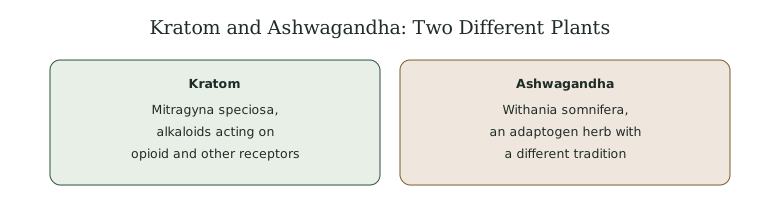
The first thing to understand is how different these plants are. Kratom is a tree native to Southeast Asia, and its effects come from alkaloids like mitragynine that act on opioid, adrenergic, and serotonergic systems, covered in the kratom science resource. Ashwagandha is a shrub central to Ayurvedic medicine, classed as an adaptogen, a category of herbs traditionally used to help the body handle stress. They share almost nothing pharmacologically. Regarding them as interchangeable or assuming their effects simply add together would be a mistake, since they act on different systems in different ways. Any discussion of combining them has to start from this fundamental difference.
What Ashwagandha Is
Ashwagandha deserves its own brief explanation, since many kratom users are less familiar with it. It is one of the most studied adaptogen herbs, traditionally used in Ayurveda and now popular in the West primarily for stress and general wellness. Its proposed effects center on modulating the body's stress response, and it is generally taken as a daily supplement rather than for an acute effect. This is quite different from how kratom is used, which is typically for a more immediate, noticeable effect. Understanding ashwagandha as a slow-acting, stress-oriented daily herb, rather than something that produces an acute experience like kratom, clarifies why the two are used so differently.
The Combination Reports
Some people combine kratom and ashwagandha, and the reports deserve honest framing. The rationale users give is usually that ashwagandha's stress-modulating reputation might complement kratom, or that it might smooth some of kratom's rougher edges. These are user rationales and anecdotal reports, not findings from controlled study of the combination, which does not exist. So anyone reading that the pairing works well should understand they are reading personal experience, not evidence. The honest position is that some users report using them together without obvious problems, but there is no research establishing either a benefit or the safety of the specific combination. That absence of evidence is itself important information.
The Tolerance Claim, Examined
One specific claim worth examining is that ashwagandha might help with kratom tolerance. This idea circulates in the same way various tolerance claims do, covered more fully in kratom potentiators examined. The honest assessment is that there is no solid evidence ashwagandha meaningfully affects kratom tolerance. The claim rests on general reasoning about ashwagandha's properties rather than any study of it alongside kratom. As with other tolerance claims, the reliable lever for managing kratom tolerance is frequency, not an added supplement. Approaching the ashwagandha tolerance claim with skepticism is the accurate stance, since it is a plausible-sounding idea without evidence behind it.
Why People Consider the Combination
It helps to understand why the pairing appeals to some people, even without evidence behind it. Kratom users sometimes look for something to complement their use, whether to support general wellness, to address stress that kratom does not target, or in hopes of smoothing their overall experience. Ashwagandha, with its established reputation as a stress-oriented adaptogen, naturally comes up as a candidate, since it addresses a different need than kratom does. This reasoning is understandable, and it is not inherently unreasonable to use a well-regarded stress herb alongside kratom for genuinely different purposes. The caution is simply that combining any two active botanicals introduces uncertainty, and the specific combination has not been studied, so the appeal of the pairing should be weighed against that unknown rather than assumed to be problem-free. Using ashwagandha on its own terms for stress, separately from kratom, avoids the combination question entirely, which is one sensible way to approach it.
The Interaction Unknowns
The most important honest point about combining kratom and ashwagandha is how much remains unknown. Because there is no research on this specific combination, the potential interactions are genuinely uncharted. Both substances have their own effects on the body, and how they interact when taken together has not been studied. This matters especially for anyone taking medications, since adding two botanicals with their own properties compounds the uncertainty. The responsible approach for anyone considering the combination, particularly alongside any medication, is to consult a pharmacist or doctor rather than relying on anecdotal reports. Ground the fundamentals in kratom basics. Uncharted does not automatically mean dangerous, but it does mean caution is warranted.
A Sensible Approach
For anyone weighing whether to use these botanicals together, a sensible approach follows from everything above. Recognize first that they are different plants serving different purposes, so there is no reason to assume they work as a natural pair. If you are interested in ashwagandha for stress, consider using it on its own terms and observing its effects separately, rather than immediately combining it with kratom, which makes it impossible to tell which plant is doing what. If you do choose to use both, and especially if you take any medication, consult a pharmacist or doctor first, since the combination is unstudied and the interactions are unknown. And keep the tolerance claim in perspective, since managing kratom tolerance is reliably done through frequency rather than through any added supplement. This measured approach lets you explore either botanical thoughtfully without assuming benefits or safety that the evidence does not support.
The Bottom Line on Kratom and Ashwagandha
Kratom and ashwagandha are two fundamentally different botanicals, one a Southeast Asian tree acting on opioid and other receptors, the other an Ayurvedic adaptogen herb used mainly for stress. They share little pharmacologically, so combining them is not a matter of stacking similar effects. Some users report using them together and suggest ashwagandha might complement kratom or help with tolerance, but these are anecdotal rationales, not evidence, and no research studies the combination. The tolerance claim in particular lacks support. Because the specific interaction is genuinely unstudied, anyone considering the pairing, especially alongside medication, should consult a healthcare professional rather than trust reports. The honest summary is that this combination is uncharted territory, and caution is the appropriate stance.
Frequently Asked Questions
Can you take kratom and ashwagandha together?
Some users report doing so, but no research studies the combination, so the interactions are genuinely unstudied. Anyone considering it, especially alongside medication, should consult a healthcare professional rather than rely on anecdotal reports.
Does ashwagandha help with kratom tolerance?
There is no solid evidence it does. The claim rests on general reasoning about ashwagandha rather than any study alongside kratom. The reliable lever for managing kratom tolerance is frequency, not an added supplement.
Are kratom and ashwagandha similar?
No. Kratom is a Southeast Asian tree acting on opioid and other receptors, while ashwagandha is an Ayurvedic adaptogen herb used mainly for stress. They share little pharmacologically and are used very differently.