
Kratom & Caffeine: Same Plant Family — Different Chemistry
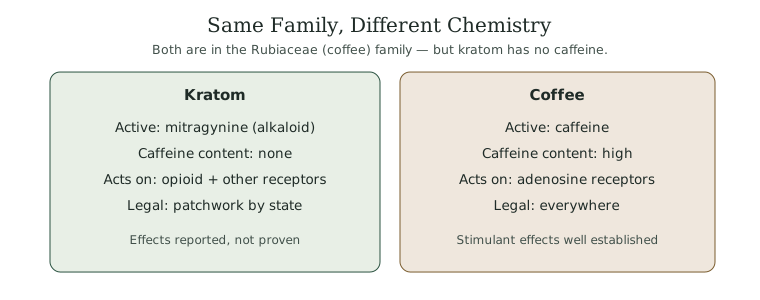
Kratom and coffee come from the same plant family, which surprises most people. Both belong to the Rubiaceae family, the botanical group commonly called the coffee family. That relationship is a genuine fun fact and a useful starting point. But the shared family tree hides a critical difference. Coffee's kick comes from caffeine. Kratom contains no caffeine at all. Its effects come from entirely different compounds. Understanding that split keeps you from making a common and risky assumption about stacking the two. It also explains why kratom does not behave like a stronger cup of coffee.
The Coffee-Family Connection
The family link is real and well documented. In a 2019 review in Substance Abuse and Rehabilitation, Charles Veltri and Oliver Grundmann describe kratom's tree, Mitragyna speciosa, as a member of the coffee family used traditionally as a stimulant during hard labor (Veltri and Grundmann, 2019). Multiple pharmacology reviews describe the same placement, noting kratom sits in the Rubiaceae family alongside coffee and has been used traditionally as a mild stimulant. So the botanical kinship is not marketing. It is taxonomy. Ground the plant itself in the kratom plant for the full picture.
Zero Caffeine, Cleared Up
Despite the family tie, kratom contains no caffeine. This trips people up because both plants are associated with energy and both grow in the tropics. But caffeine is specific to coffee, tea, and a handful of other plants. Kratom's active compounds are alkaloids like mitragynine, which work through completely different pathways, covered in kratom chemistry explained. If you are avoiding caffeine, kratom will not add any. If you are expecting a caffeine-style jolt, kratom does not deliver one through that mechanism. The energy association comes from a different place entirely.
The Low-Dose Stimulant Question
Kratom is widely said to be stimulating at low servings and sedating at higher ones, and this deserves an honest look rather than repetition. The claim is common, but the evidence is weaker than the confidence around it. In a 2019 study in Substance Use and Misuse, Darshan Singh and colleagues specifically tested whether kratom's effects tracked with the amount consumed and found no statistically significant serving-to-effect relationship in their sample (Singh et al., 2019). So the tidy low-dose-stimulant, high-dose-sedative story is a user-reported pattern, not a proven rule. The reported energy angle is explored further in kratom energy research, always framed as what surveys describe.
Combining Kratom and Coffee
Many people drink coffee and take kratom, sometimes together, and a little caution is worth stating. Coffee is a genuine stimulant through caffeine. Kratom is a separate active substance. Stacking two active substances always raises the chance of unwanted effects, and combining a caffeine stimulant with kratom can amplify jitteriness, raise heart rate, or unsettle the stomach for some people. This is not a dire warning, just a sensible one. Start with less of each when combining them, pay attention to how you feel, and do not assume that two "natural" products cancel out each other's downsides. The stimulant-stacking logic is the same one that applies to energy drinks and pre-workouts.
Kratom vs Coffee, Side by Side
The two make an instructive comparison. Coffee delivers a well-studied caffeine stimulant with a predictable, researched effect curve. Kratom delivers alkaloids with a survey-based reputation and far less controlled research behind its effects. Coffee is legal everywhere. Kratom sits in a legal patchwork, mapped on the kratom legality map. Coffee's safety profile is thoroughly characterized. Kratom's is still being studied. If you want a predictable, well-understood energy source, coffee is the researched option. Kratom is a different plant with a different, less-settled profile, and calling it "herbal coffee" oversimplifies both.
The Matcha and Tea Comparison
People also compare kratom to matcha and green tea, and the same principle applies. Matcha and tea contain caffeine plus L-theanine, a combination researched for smooth, sustained energy. Kratom contains neither. It is not a caffeine product and does not share matcha's mechanism. If a smooth caffeine experience is the goal, tea and matcha are the evidence-backed choices. Kratom appears in some ready-to-drink products alongside these, covered in kratom drinks and seltzers, but the presence of both in one beverage does not make them chemically similar. They are different tools that happen to share a shelf.
Why People Confuse the Two
The kratom-coffee confusion runs deeper than the shared family name, and it is worth unpacking. Both plants are associated with energy and productivity in their traditional settings. Both grow in tropical regions. Both are consumed as brewed drinks in their home cultures. And both are marketed to Western consumers as pick-me-ups. Those surface similarities make "kratom is basically herbal coffee" an easy shorthand. It is also wrong in the ways that matter most. The mechanisms differ, the research base differs enormously, the legal status differs, and the safety profiles are not comparable. Coffee is one of the most studied consumables on earth. Kratom's effects rest largely on surveys. Calling the two equivalent imports coffee's reassuring familiarity onto a plant that has not earned it through the same depth of research. Keeping the distinction clear protects you from assuming kratom is as well understood as your morning cup, which it is not. The family tree is a genuine and interesting fact. It is simply not a license to use one plant as a swap for the other. Coffee is coffee, and kratom is kratom, and the shelf they share is very nearly the only thing they truly have in common as everyday consumer products.
The Bottom Line on Kratom and Caffeine
Kratom and coffee are botanical cousins in the Rubiaceae family, and that is where the similarity ends. Kratom contains no caffeine, works through different compounds, and carries a survey-based reputation rather than coffee's well-researched profile. The popular low-dose-stimulant story is a user report, not a proven rule. If you combine kratom with coffee or other caffeine, approach it as stacking two active substances and start low. For predictable, researched energy, caffeine sources like coffee and tea are the settled choice. Kratom is a genuinely different plant, and the family tree is a fun fact, not a substitution guide. Explore the broader kratom science resource for how these comparisons fit the wider evidence, and see the related botanical pairing in ashwagandha and kratom examined.
Frequently Asked Questions
Does kratom contain caffeine?
No. Although kratom is in the Rubiaceae coffee family, it contains no caffeine. Its effects come from alkaloids like mitragynine, which work through entirely different pathways.
Is kratom stimulating at low doses?
That is a common user-reported pattern, but the evidence is weak. A 2019 study found no statistically significant relationship between the amount taken and stimulant or sedative effects.
Can you take kratom and coffee together?
People do, but it stacks two active substances. Combining caffeine with kratom can amplify jitteriness, heart rate, or stomach upset for some. Start with less of each and see how you feel.