
Kratom and Relaxation: What Users Report and What Research Shows
Many kratom users report using it to relax, and this page examines what the evidence says about that, framed strictly as what surveys and research show rather than as any promise. Kratom is traditionally associated with calming effects, especially with red-vein strains and at higher servings, but the honest picture has real limits. Survey data tells us how users describe kratom's relaxing reputation, while the controlled research needed to confirm it as a proven effect largely does not exist. Separating those two is the point of an honest relaxation discussion.
What the Survey Data Shows
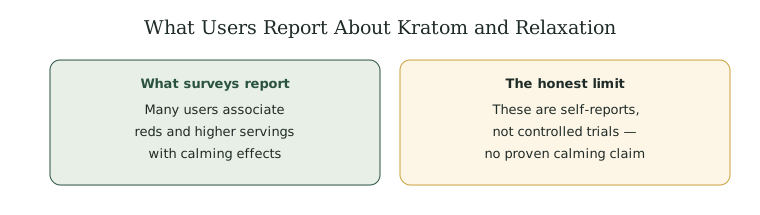
User surveys document relaxation and relief from tension among the common reasons people use kratom. Large survey work has found anxiety relief and mood among the frequently reported reasons for use, alongside pain and energy. This tells us that a calming experience is a genuine part of how many people describe kratom. What it does not tell us is that kratom reliably produces relaxation as a proven pharmacological effect, since a survey records what people report rather than what a controlled trial would confirm. Ground your serving approach in the kratom dosage guide, and note that no effect described here is a promise.
The Red Vein Association
The relaxation conversation centers heavily on red-vein strains. User surveys and community reports consistently associate reds with slower-paced, calming, evening-leaning effects, covered in the red vein kratom guide. This association is one of the strongest in kratom's survey-based reputation, but it remains reputation rather than proven pharmacology. The reliable evidence for a fixed red-equals-relaxation rule is thin. If you are exploring kratom for its calming reputation, reds are where users point, but weigh a consistent serving and keep your own notes rather than trusting the color to deliver a promised effect.
The Dose-Dependence Pattern
Kratom's calming reputation is tied to the same dose-dependence idea that governs its energy reputation, in reverse. Users widely report that higher servings lean more sedating and calming, while lower servings lean more stimulating. As with the energy side, this is a widely-held user pattern rather than a proven rule, and some research testing whether effects track with the amount taken has not found a clear statistical relationship. So the higher-serving-relaxation idea is survey-based reputation. If you explore kratom for relaxation, a moderate rather than minimal serving is where users report calming effects, but there is no guarantee your experience will match the pattern, and larger servings carry their own cautions.
Relaxation and Sleep
The relaxation reputation overlaps with sleep, since a calming effect naturally connects to winding down. The specific evidence around kratom and sleep, which is even more limited, is covered in kratom and sleep research. The honest distinction is that relaxation and sleep are related but not identical, and the survey-based calming reputation does not establish kratom as a sleep aid. Anyone using kratom to relax in the evening should understand that its effects on actual sleep quality and architecture are not well studied, which is its own important limit.
The Honest Limits of the Evidence
As with every effect discussion, the crucial part is naming what we do not know. There are no rigorous clinical trials establishing kratom as an effective relaxation aid, no approved use for that purpose, and no standardized product that would make such a claim meaningful. What exists is a consistent body of user reports describing calming effects, especially with red strains and at higher servings. That is genuine information about how people experience kratom, but it is not proof. Anyone approaching kratom to relax should hold both truths: the reputation is real and widely reported, and the controlled evidence to confirm it is not there. Ground the fundamentals in kratom 101.
Relaxation Reputation Versus Proven Approaches
It is worth placing kratom's calming reputation next to approaches whose relaxing effects are better established. Practices like regular exercise, breathing techniques, and structured relaxation methods have real research support for reducing tension, and they carry none of the tolerance or dependence concerns that come with a substance used regularly. Kratom's relaxation reputation, by contrast, rests on user reports rather than controlled study. This does not make the reports meaningless, since their consistency reflects genuine experience, but it does mean kratom sits on weaker evidential ground than established relaxation approaches. For someone whose main goal is reliable, sustainable calm, the well-founded approaches are the rational first choice, with kratom as a less-studied option a person might explore while understanding its evidence is thinner. Naming that difference lets you choose with clear eyes rather than assuming a survey-based reputation carries the weight of proven effect, which it does not.
If you explore kratom's calming reputation, a few honest habits keep it sensible. Choose a red-vein strain, since reds carry the strongest calming reputation, but verify the product by its certificate of analysis rather than trusting the color to deliver. Weigh a consistent, moderate serving, since users associate calm with moderate rather than minimal amounts, while remembering that larger servings carry their own cautions. Keep notes on how each serving actually affects you, because your own response is the only reliable data and may not match the survey pattern. Keep your frequency low, since relying on kratom to unwind every evening is exactly the habitual pattern most associated with tolerance and dependence. And separate relaxation from sleep in your own mind, since feeling calm before bed is not the same as sleeping well. Approached this way, exploring kratom to relax becomes a careful personal experiment rather than trust in a reputation, and honest notes on your own experience will guide you better than any strain chart or survey summary can about whether kratom actually delivers the calm you are seeking. The reputation points the way, but only your own honest experience can settle whether it holds true for you. Approach the reputation as a hypothesis to test rather than a fact to trust, and let your own notes decide.
The Bottom Line on Kratom and Relaxation
Kratom has a genuine, widely reported reputation for relaxation, especially with red-vein strains and at higher servings, documented in user surveys as a common reason for use. But that reputation is survey-based self-report, not proven pharmacology, and the controlled trials needed to establish kratom as an effective relaxation aid do not exist. The red-vein association is one of the strongest in kratom's reputation, yet it remains reputation rather than proof. If you explore kratom to relax, do so understanding that you are following a user-reported pattern rather than a proven effect, weigh a consistent serving, and keep honest notes on your own response.
Frequently Asked Questions
Does kratom help you relax?
Many users report calming effects, especially with red-vein strains and at higher servings, and surveys document relaxation among common reasons for use. But these are self-reports, not proven pharmacological effects confirmed by trials.
Which kratom strains are most relaxing?
User surveys most strongly associate red-vein strains with calming, evening-leaning effects. This is one of the strongest survey-based associations, but it remains reputation rather than proven pharmacology.
Is kratom relaxation the same as a sleep aid?
No. Relaxation and sleep are related but not identical. The calming reputation does not establish kratom as a sleep aid, and its effects on actual sleep quality are not well studied.