
Kratom and Energy: What Users Report and What Research Shows
Many kratom users report using it for energy, and this page examines what the evidence actually says about that, framed strictly as what surveys and research show rather than as any promise. Kratom is traditionally associated with stimulation, especially at lower servings and with certain strains, but the honest picture involves real limits. Survey data tells us how users describe kratom's energizing reputation, while the controlled research needed to confirm it as a proven effect largely does not exist. Separating those two is the whole point of an honest energy discussion.
What the Survey Data Shows
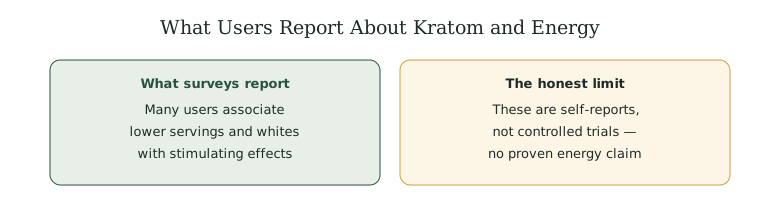
User surveys consistently document energy as a common reason people use kratom. In a 2020 study in Drug and Alcohol Dependence, Albert Garcia-Romeu and colleagues surveyed nearly 2,800 users and found energy and focus among the reported reasons for use, alongside pain, anxiety, and mood (Garcia-Romeu et al., 2020). This tells us that a stimulating experience is a genuine part of how many people describe kratom. What it does not tell us is that kratom reliably produces energy as a proven pharmacological effect, since a survey records what people report, not what a controlled trial would confirm. Ground your serving approach in the kratom dosage guide.
The Dose-Dependence Reputation
Kratom is widely said to be stimulating at lower servings and more sedating at higher ones, and this pattern is central to the energy discussion. The reputation is real in the sense that many users describe it, but the controlled evidence is weaker than the confidence around it. Some research has specifically tested whether kratom's effects track with the amount taken and found no clear statistical relationship, which complicates the tidy low-serving-stimulant story. So the dose-dependence idea is a widely-held user pattern rather than a proven rule. If you are exploring kratom for daytime energy, a lower weighed serving is where users report stimulation, but there is no guarantee your experience will match the pattern.
Which Strains Users Associate With Energy
Strain reputation plays a large role in the energy conversation. User surveys and community reports tend to associate white-vein and some green-vein strains with more stimulating, daytime-leaning effects, covered in the white vein kratom guide and the green vein kratom guide. These associations are survey-based reputation, not proven pharmacology, and the reliable evidence for fixed strain-to-effect rules is thin. If you want to explore kratom's energizing reputation, whites and greens are where users point, but weigh a consistent serving and keep your own notes rather than trusting the color to deliver.
Kratom, Caffeine, and Energy
Because kratom is in the coffee family, people naturally compare its energy reputation to caffeine, and the comparison is clarifying. Kratom contains no caffeine and works through entirely different compounds, covered in kratom and caffeine together. Its energizing reputation, where it exists, comes from its own alkaloids, not from a caffeine-style mechanism. This matters for anyone combining the two, since stacking kratom with caffeine means stacking two active substances. For a predictable, well-researched energy source, caffeine has far more evidence behind it than kratom's survey-based energy reputation.
The Honest Limits of the Evidence
The most important part of an energy discussion is naming what we do not know. There are no rigorous clinical trials establishing kratom as an effective energy aid, no approved use for that purpose, and no standardized product that would make such a claim meaningful. What exists is a consistent body of user reports describing energizing effects, especially at lower servings and with certain strains. That is genuine information about how people experience kratom, but it is not proof. Anyone approaching kratom for energy should hold both truths: the reputation is real and widely reported, and the controlled evidence to confirm it is not there. Ground the fundamentals in kratom basics.
Energy Reputation Versus Proven Stimulants
It helps to place kratom's energy reputation next to substances whose stimulant effects are actually established. Caffeine, for example, has decades of research behind its effects on alertness and fatigue, a well-characterized dose-response curve, and a predictable duration. Kratom has none of that rigor behind its energy reputation, only survey reports and traditional use. This does not mean kratom does nothing, since the consistency of user reports is itself meaningful, but it does mean the two sit on very different evidential footing. If reliable, well-understood energy is the goal, the proven stimulants are the rational choice, and kratom is the less-studied option a person might explore for their own reasons while understanding that they are venturing beyond what research can confirm. Naming that difference honestly lets you make an informed decision rather than assuming kratom's energy reputation carries the same weight as a researched stimulant's, which it does not.
If you decide to explore kratom's energizing reputation, a few honest habits keep the exploration sensible. Start with a lower weighed serving, since that is where users most consistently report stimulation, and increase only cautiously on a later day if at all. Choose a white or green strain, since those carry the daytime reputation, but verify the product by its certificate of analysis rather than trusting the color. Keep detailed notes on how each serving actually affects you, because your response is the only data that truly matters, and it may not match the survey pattern. Avoid stacking kratom with caffeine or other stimulants until you know your own reaction, since combining actives raises the chance of jitteriness or an unsettled stomach. And keep your frequency low, because the energizing reputation fades fastest for daily users as tolerance builds. Approached this way, exploring kratom for energy becomes a careful personal experiment rather than a leap of faith in a reputation, and your own honest notes will tell you far more than any survey or strain chart ever could about whether kratom delivers the energy you are looking for. The reputation may draw you in, but only your own careful experience can confirm or deny it. Regard the reputation as a hypothesis to test, not a fact to trust, and let your notes be the judge.
The Bottom Line on Kratom and Energy
Kratom has a genuine, widely reported reputation for energy, especially at lower servings and with white and green strains, documented in user surveys as a common reason for use. But that reputation is survey-based self-report, not proven pharmacology, and the controlled trials needed to establish kratom as an effective energy aid do not exist. Kratom contains no caffeine and works through its own alkaloids, so its energizing reputation is distinct from a caffeine mechanism. If you explore kratom for energy, do so understanding that you are following a user-reported pattern rather than a proven effect, weigh a consistent serving, and keep honest notes on your own response.
Frequently Asked Questions
Does kratom give you energy?
Many users report energizing effects, especially at lower servings and with white or green strains, and surveys document energy as a common reason for use. But these are self-reports, not proven pharmacological effects confirmed by trials.
Which kratom strains are most energizing?
User surveys tend to associate white-vein and some green-vein strains with more stimulating effects. This is survey-based reputation, not proven pharmacology, so weigh a consistent serving and keep your own notes.
Is kratom like caffeine for energy?
No. Kratom contains no caffeine and works through different compounds. Its energizing reputation comes from its own alkaloids. Caffeine has far more evidence behind it as a predictable energy source.